Check out our latest products
![[2025 Upgraded] Retractable Car Charger, SUPERONE 69W Car Phone Charger with Cables Fast Charging, Gifts for Men Women Car Accessories for iPhone 16 15 14 13 12, Samsung, Black](https://i1.wp.com/m.media-amazon.com/images/I/61SaegZpsSL._AC_SL1500_.jpg?w=300&resize=300,300&ssl=1)


Fifteen years ago, when my creative journey was on the starting line, my colleagues and I used to joke that transcribing hours of interviews, especially in a foreign language, was the kind of task hell would outsource. Not so anymore. Not only do we have AI-powered tools at hand that generate transcripts and subtitles in mere seconds, but we can also easily apply them for text-based editing. What is it? An immensely helpful way to streamline your work if you are swimming in documentary interviews, recordings of group discussions, or other speech-based formats. If it’s not part of your toolkit yet, welcome! The subsequent article aims to provide you with a hands-on introduction.
Artificial tools are not all evil if you look closer. Some offer a helping hand in everyday tasks, as they are tailored to support your creativity, rather than replace it. This is the angle that we decided to explore in our MZed course series “The Efficient Filmmaker.” The first course is called “Subtitles Mastery,” and it’s all about accelerating your workflow connected to transcripts, subtitles, captions, and translations – in other words, a mundane yet essential part of an editor’s work. One of the modules is dedicated solely to text-based editing, and I’d like to give you a sneak peek.
Head over here if you are interested in watching the entire course.
What is text-based editing at its core?
Text-based editing is something we can think of as a classic “paper cut,” but in digital form.
Imagine you have a printed transcript of a filmed interview in front of you. You cut the lines into meaningful pieces and rearrange them over and over again until they form a decent story structure. Some statements land in the garbage bin, others are moved to different places and are glued together, creating new connections and transitions. Once you are happy with the draft, you launch the NLE and can actually start editing.
That’s how a lot of creators approached documentaries, reportages, and other speech-based formats in the past (including me). Nowadays, we can skip the “printing” and “cutting” part altogether and go through the same process directly in the editing software. The biggest difference, though, is that when you select portions of the transcript, drag and drop them onto the timeline, or rearrange them in the text tab, the corresponding video clips follow along. You make and fine-tune your rough cut precisely according to the script or story structure. That’s what text-based editing basically means.
Obviously, to apply it, you’ll first need the full transcript of your spoken parts: dialogue, interview statements, or group discussions. Transcribing can be, again, done manually or handed over to dedicated AI-powered tools.
Applications for text-based editing
The good thing about automated transcription and AI-generated subtitles is that, at this point in time, almost all leading post-production applications have integrated these tools into their software, and now they’re part of the standard interface. So, it doesn’t require any extra effort from your side – you just need to know where to find them and how to use them.
For instance, in Adobe Premiere Pro, you enable the Text tab, select the audio track you want an AI-generated transcript for, and then hit “Transcribe.”

In DaVinci Resolve, the transcription tool is hidden behind a right click on your file in the Media Pool folder – AI Tools – Audio Transcription – Transcribe. (I say “hidden” because you won’t use the same route provided you only need subtitles for your timeline.) Similar in Avid: Right-click on the clip in the bin – Transcript – Transcribe.

Of course, if you only need text-based editing occasionally and don’t really want to tie knots with one of the major NLEs (metaphorically and financially speaking), there are a bunch of third-party solutions available for the same task. Perhaps the most well-known service in this area is called Simon Says. It offers both caption creation and text-based editing features, alongside other AI-based products, such as translation. Simon Says is available as a web-based application, and you can either get their subscription or pay as you go (meaning: a fixed sum per minute of transcribed material).
Step-by-step guide
In the MZed course “Subtitles Mastery,” we touch on text-based editing workflows in DaVinci Resolve, Adobe Premiere Pro, and Avid Media Composer. However, they offer quite similar tools, so once you have acquired this skill in one editing software, it’s not difficult to apply it to another. Below, I’ll show you the quickest text-based editing approach, using Adobe Premiere Pro as an example.
- When you create a new project, Premiere will launch an Import window (if you haven’t set it otherwise). Inside it, you can already upload your interview file, and enable “Automatic transcription” in the tab on your right. Toggle off “Create new sequence,” or otherwise the program will throw your footage onto the timeline, which we don’t need for text-based editing. Make sure to set up the “Auto-transcribe all imported clips” function if you want the software’s AI to generate transcripts for all the files right off the bat. There is also an option to automatically label different speakers, in case you have more than one person talking.
- After you click “Import,” you will see your interview files in the Project tab, but you won’t find the transcript in the Text tab – at least not right away. The AI will need some time to transcribe it. So, wait a little bit – and here you go! A fully generated transcript at your fingertips. It is also interactive. Meaning: When you jump to a place in the script, the playhead will also jump to the corresponding place in the video.
- Next step: We need to switch to the correct workspace. For that, go to Window – Workspaces – Text-Based Editing.
- Now you’re all set and can start editing. Highlight the first piece of the interview in the transcript, click on the video in the Source window, and drag and drop it onto the open timeline. Premiere will automatically set in and out marks and pick only the selected part of the video.
- Most likely, your transcript will jump to a new window, where only the selected interview part will be visible. This is the transcript of your sequence, for later refinements. For now, you want to stay on the overall transcript, so uncheck the box “Follow active monitor” at the bottom of the Text tab.
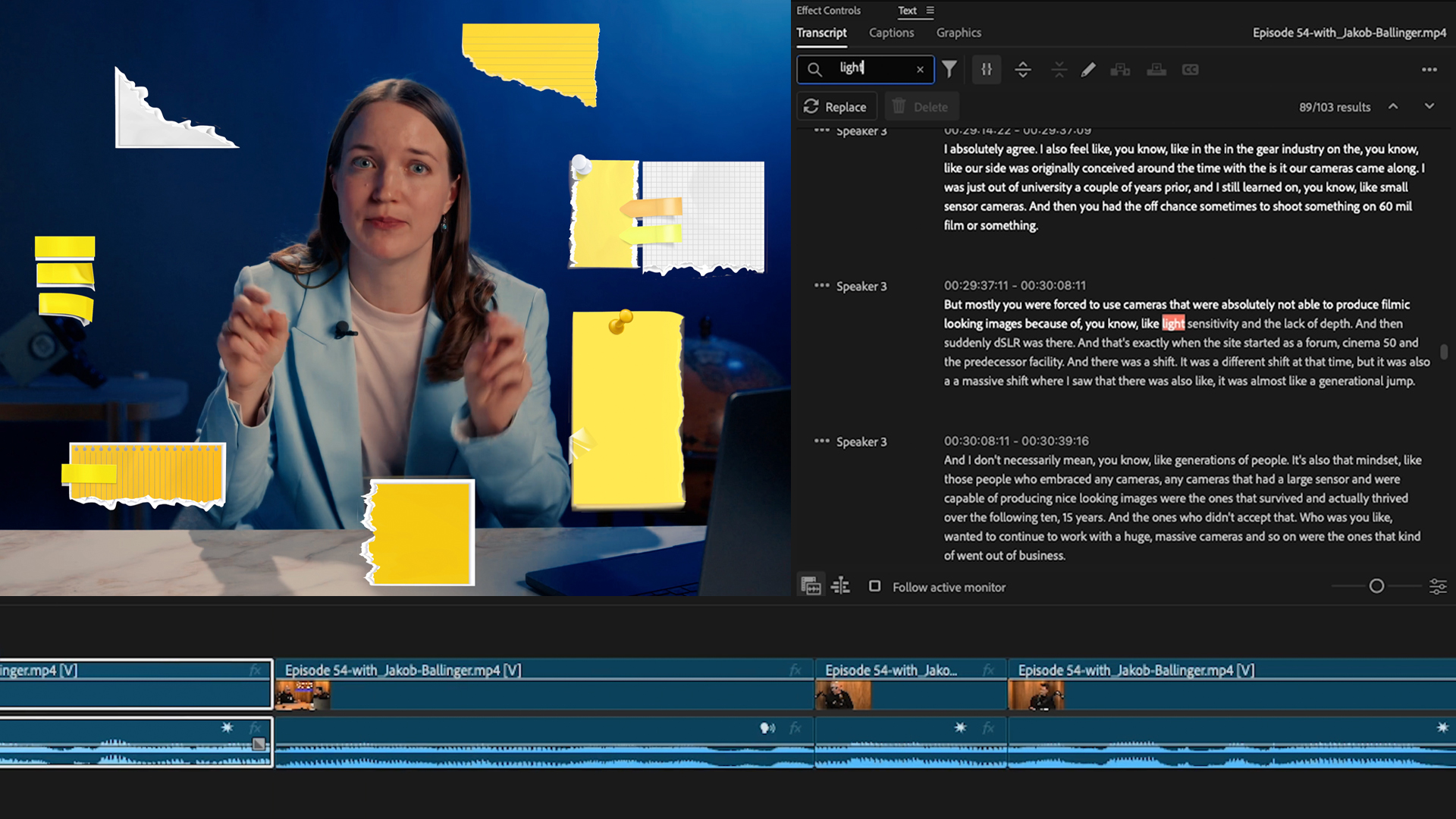
- Repeat this process as many times as you need to. You can use the search field to look for specific terms, phrases, or content. This will help to speed up the navigation when you already have an idea of how to structure the video.
- When the rough cut looks promising, you can either edit it further directly on the timeline or you can switch to the sequence transcript and work with the text. (For that, click on the icon left of “Follow active monitor.” Try deleting a part of the phrase there, and you will see how the program removes the dedicated chunk of the clip as well.


Neat, isn’t it? Additionally, it’s a quick and effective way to cut a trailer or put together a fun intro. For instance, in the course demo, I searched for various phrases with “light” from the podcast episode (as this was the topic) and combined them for a dynamic lead-in.
The future of editing
All in all, text-based editing is a great way to put together a first rough structure of the story, and it’s definitely faster than a classic paper cut. However, as technology continues to evolve, the future has even more to offer.
For example, recently, the AI-powered assistant editor Eddie AI launched a “Scripted” mode. This new feature automatically cuts video to match uploaded scripts in minutes (DaVinci Resolve presented something similar in their latest version as well). Now, the whole process could become even quicker: You provide AI with a script and raw footage, it aligns them into a clean string-out, and gets it ready for an NLE of your choice. Personally, I haven’t tried it yet, but it sounds as though it could save a lot of time and effort in creating the first rough cut.
What do you think? Where do you see the future of editing? Have you implemented a text-based editing approach in your projects? If so, what further tips could you share with our filmmaking community? Let’s meet in the comments below!
Full disclosure: MZed is owned by CineD.
Feature image source: MZed.
![[True Military-Grade] Car Phone Holder【2024 Stronger Suction & Clip】 Universal Cell Phone Holder for Car Mount for Dashboard Windshield Air Vent Long Arm Cell Phone Car Mount Thick Case,Black](https://i2.wp.com/m.media-amazon.com/images/I/715PBCuJezL._AC_SL1500_.jpg?w=300&resize=300,300&ssl=1)
![[エレコム] スマホショルダー ショルダーストラップ 肩掛け ストラップホールシート付属 丸紐 8mm P-STSDH2R08](https://i3.wp.com/m.media-amazon.com/images/I/51BMFf06pxL._AC_SL1500_.jpg?w=300&resize=300,300&ssl=1)